#1 The new safety problem in smart car parks
A new type of car park is appearing across Hong Kong. Government parking facilities are combining automated parking racks with integrated EV chargers to make better use of limited space while supporting the shift to electric vehicles. In these systems, vehicles are lifted and moved by mechanical platforms, often in relatively dimly lit, confined areas where cars, motor bikes, pedestrians and service staff share the same zone.
This combination of MECHANICAL MOVEMENT, HIGH-POWER CHARGING and MIXED TRAFFIC creates a scenario that has not really existed before. There are very few, if any, reference installations of EV chargers mounted directly on or installed behind automated parking racks, even in other parts of the world. That means there is no established safety blueprint to follow. Operators and integrators are facing a genuinely new set of risks.
The challenge is not just about moving cars safely. It is about protecting a complex, moving environment that also includes high‑power charging equipment. Objects in the wrong place, whether small or large, can quickly become serious hazards and trigger a chain of problems:
- A charger is in use and the charging cable is plugged into a vehicle, increasing the vehicle’s overall width beyond the platform edge.
- A stray charging cable, tool, or piece of debris may be left between parking bays. In some cases, drivers may carelessly leave the charging cable on the platform after charging.
- A child or pet wanders into the rack zone while a platform is about to move.
- Small items fall from higher levels into the path of a moving platform.
These issues can lead to:
- Mechanical jams or damage to the rack structure, motors, vehicles or EV charging hardware.
- Fire or electrical hazards where damaged cables or chargers interact with high‑current equipment.
- Operational and commercial impact, including downtime, warranty disputes, insurance complications and reputational risk for operators and building owners.
- Or even worse, endanger and cause bodily harm to passengers, drivers and field staff.
#2 Introducing Micro‑Object Detection
Micro-Object Detection performs a highly demanding task. It monitors the rack’s movement zone to ensure that no hazardous objects are present when the platform moves. The system can reliably detect objects as small as 1 cm within the rack’s operating area. It is designed to perform in a range of conditions, including outdoor, nighttime, and low-light environments typical of underground and semi-underground car parks, where visibility is limited and shadows are common.
2.1 Why Micro‑Object Detection is technically challenging?
Small size and low contrast
A 1 cm black cable on a dark, worn floor reflects very little light and can blend into the background. Traditional sensors or security systems tuned for large, high‑contrast objects like cars and people may simply not “see” it.
Complex backgrounds
The rack zone includes metal structures, moving platforms, charging equipment, painted lines, oil stains and wet patches. These create shadows, reflections and texture variations that can easily confuse simpler detection methods.
Clutter and occlusion
Cables, vehicles and people can partially block each other. The system must distinguish between harmless background items and genuine hazards in the path of motion.
Lighting conditions
Underground car parks often have uneven lighting, with bright areas near chargers and deep shadows elsewhere. By contrast, outdoor environments may be affected by sunlight, fog, and mist. The sensing solution must remain stable across these changing conditions without requiring constant recalibration.
Safety‑critical reliability
Unlike a camera that merely records footage, this system must make real‑time decisions that directly affect whether a platform is allowed to move. False negatives (missing a hazard) and excessive false alarms (blocking operation unnecessarily) are both unacceptable.
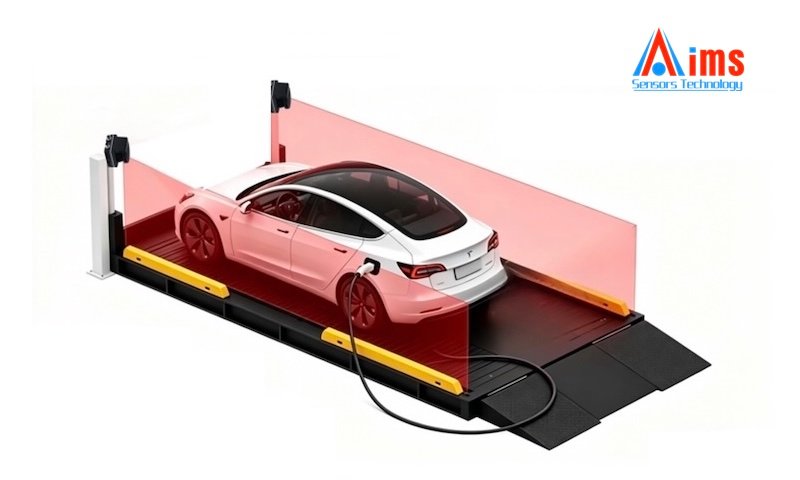
To meet these challenges, Micro-Object Detection is designed to identify small, low-contrast, and irregularly shaped objects in complex, dynamic scenes. It uses high-density LiDAR combined with AI-based processing to create a virtual safety curtain, enabling highly accurate detection of potential hazards.
The result is a system that provides a dedicated safety layer for some of the most demanding sensing environments, from automated parking racks with EV chargers to other high-risk spaces where small objects and moving machinery coexist.
#3 Why infrared and through‑beam “band‑aid” solutions can't solve the problem?
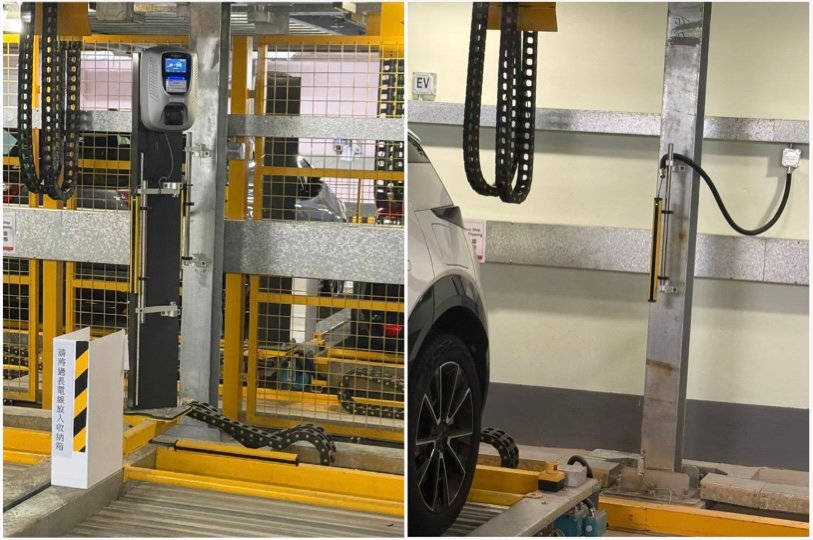
One recently opened facility in Cheung Kwan O uses what can best be described as a band‑aid approach: a cable management box mounted on the front of the charging station, combined with through‑beam light grids installed at the front and rear of the garage to create one or more detection lines.
This setup adds a basic level of protection, but it comes with well‑known common limitations:
Highly sensitive to alignment
Through‑beam sensors require the transmitter and receiver to stay precisely aimed at each other. Mechanical vibration from nearby motors, pumps or moving racks can gradually shift the mounts, causing the optical axis to drift and creating blind spots. Even a small physical bump can knock the system out of alignment and force recalibration.
Environmental sensitivity
Dust, oil mist, condensation, and dirt on the lenses reduce the available light margin and can lead to missed detections or false trips. In underground car parks, where humidity and vehicle exhaust are common, performance can drift over time, making frequent cleaning and checks necessary.
In outdoor or semi-outdoor installations, these issues are further amplified by rain, fog, direct sunlight, and temperature extremes, which can interfere with the receiver, accelerate lens contamination, and destabilize alignment. As a result, through-beam and light-grid solutions in exposed environments often require higher-grade protection, more robust shielding, and more frequent maintenance to remain reliable.
3.1 Operational impact
In practice, these limitations mean that beam-based “band-aid” solutions can miss small hazards and require significant attention. The impact goes beyond occasional inconvenience: maintenance teams face higher overhead for alignment checks, lens cleaning, and troubleshooting, especially in large multi-level facilities.
Causing Frequent Accidents
Physical vulnerability in the parking bay is another major issue. The front pole that carries the transmitter or receiver is located directly in the parking bay, exactly where drivers maneuver when reversing. In a typical parking bay, no such pole would exist. In day-to-day use, these poles are frequently struck by vehicles, leading to repeated damage, misalignment, and costly repairs. Each impact reduces the reliability of the detection system and creates yet another source of downtime and maintenance work.
Micro-Object Detection is designed to replace these piecemeal light-grid and cable-box setups with a single, integrated sensing layer. By using high-density LiDAR and AI-based processing to monitor the full movement zone, it provides a solution that is more cost-effective, more accurate, and more reliable over the life of the installation, while eliminating the ongoing burden of beam alignment and frequent maintenance.
#4 How Our Micro-Object Detection System Works
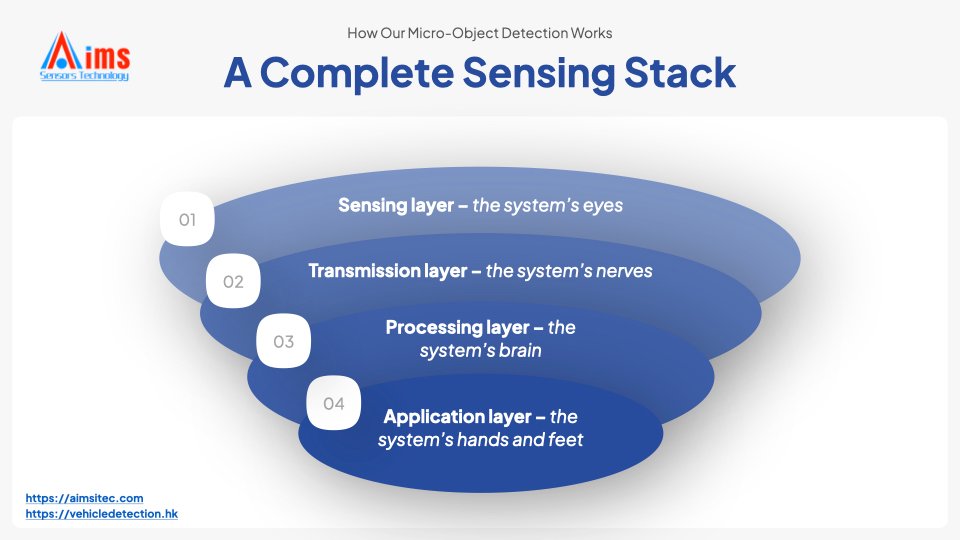
Micro-Object Detection is a complete sensing stack, covering everything from raw data capture to real-time safety decisions. Its architecture can be described in four layers.
Sensing layer – the system’s eyes
The sensing layer consists of BEA VisioScan LiDAR units installed at the rear corners on both sides of each parking bay in the automated rack.
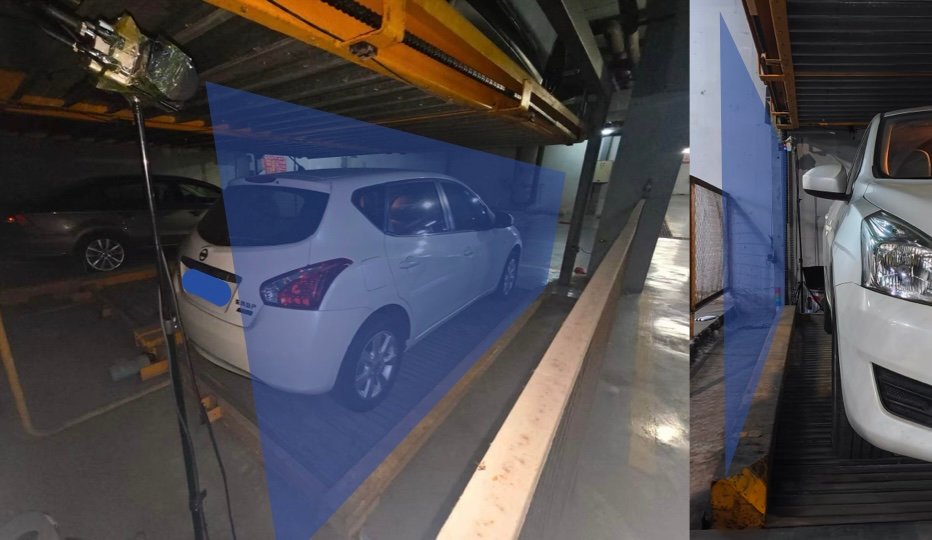
These sensors emit laser beams to form a dense vertical light curtain that scans a 275° vertical plane, precisely matching the length and height of the gaps on either side. This configuration provides full-path coverage of the movement zone, with no blind spots where hazards could occur.
Key characteristics of this layer include:
- 6 mm distance measurement accuracy, enabling the system to detect centimeter-level shifts in cables, tools, or other small objects.
- IP67 rating, providing dust and water resistance for reliable operation in the humid, dusty, and oily conditions typical of underground car parks.
- Sub-10 ms response time, allowing the system to literally capture any tiny, dynamic changes in real time.
Transmission layer – the system’s nerves
Raw point cloud and status data from the BEA VisioScan units are transmitted via an Ethernet module to the processing unit.
This high-speed wired connection ensures that safety-critical data reaches the gateway with minimal latency and high reliability, enabling consistent and timely hazard detection.
Processing layer – the system’s brain
At the core of the system is an advanced computing unit that acts as the brain.
It processes incoming LiDAR data in real time by:
- Extracting key features such as object size, shape, position, and motion patterns.
- Comparing these features against baseline models of normal conditions and known hazard patterns.
- Classifying the situation into fault or hazard levels, such as “no hazard,” “small object detected,” or “critical obstruction in the movement zone.”
The computing unit is equipped with approximately 10 TOPS of AI compute, enabling on-device fusion of raw sensor data with AI models. This allows the system to deliver accurate, context-aware decisions without relying on remote cloud servers, which is essential for safety-critical operations.
Application layer – the system’s hands and feet
The application layer translates detection results into actionable outcomes
- A visualization terminal, such as an HMI, SCADA screen, or web dashboard, displays the real-time status of each rack and movement zone.
- The system generates graded warnings and alerts, including visual and audible alarms for field staff, or digital signals to the rack controller to stop movement.
- Events are logged for maintenance, auditing, and incident analysis, providing operators with a clear record of hazards and system responses.
Together, these four layers form a closed loop: the BEA VisioScan sensors monitor the environment, the network transmits the data, the edge AI processes it, and the application layer acts on the results to help keep people, vehicles, and equipment safe.
#5 Why Us: Expertise, Experience, and Tailored Solutions
Micro-Object Detection is not an off-the-shelf add-on. It is the result of deep sensing expertise applied to a new use case. That is why the right partner needs more than generic hardware knowledge—they need proven experience in vehicle sensing, complex environments, and custom system design.
5.1 Specialized in Vehicle Sensing
Our company specializes in sensing solutions for vehicle detection, counting, measurement, and classification. This background matters because it means we already understand:
- how vehicles behave in constrained spaces such as car parks, toll plazas, and freight yards;
- how to design sensing zones/ systems that align with real operational flows rather than theoretical diagrams;
- how to integrate detection outputs with control systems that manage barriers, gates, racks, and chargers.
Micro-Object Detection extends this expertise from vehicle-scale sensing to object-scale sensing, using the same disciplined approach to system design and integration.
5.2 Experience in Complex Environments
Our portfolio spans logistics and freight centers, transit and passenger hubs, as well as parking and access control. These are precisely the kinds of environments where sensing systems must perform reliably under challenging conditions, including:
Mixed traffic: cars, vans, trucks, e-bikes, and pedestrians sharing the same space.
Harsh conditions: dust, humidity, oil, temperature fluctuations, and uneven lighting.
High availability requirements: systems that must operate 24/7 with minimal false alarms and downtime.
This experience translates directly into more robust designs for automated racks with EV chargers, where reliability and safety are non-negotiable.
5.3 First to market with Micro-Object Detection for automated racks + EV chargers
We are the first company to introduce a dedicated Micro-Object Detection solution for Hong Kong’s automated parking rack and EV charger market. This first-mover position reflects more than timing; it demonstrates:
early recognition of the unique hazard profile created by combining mechanical racks with high-power charging;
investment in R&D to adapt high-density LiDAR and AI processing to this specific application;
a willingness to work closely with early adopters to refine the solution in real-world installations.
For developers, operators, and integrators, this means working with a team that already understands the problem space and offers a purpose-built solution, rather than a repurposed generic sensor.
5.4 Custom sensing solutions, not just off-the-shelf packages
Beyond standard products, our company designs and builds bespoke sensing systems for specialized industrial and infrastructure projects. With an in-house engineering team spanning AI, optics, software, and electrical design, we turn unique concepts into end-to-end sensing solutions that go far beyond off-the-shelf packages.
This capability is critical for Micro-Object Detection because:
every rack layout, charger configuration, and operating rule set is slightly different;
safety logic, alarm levels, and integration points must be tailored to each project’s control architecture;
future requirements, such as additional zones, new hazard types, or integration with building management systems, can be accommodated without starting from scratch.
In short, we are not just supplying a sensor. We are delivering a custom-engineered safety layer, backed by a team that can adapt the system as the market and technology evolve.
#6 See it live: on‑site demo in Causeway Bay
If you are evaluating safety solutions for automated parking racks with EV chargers, or planning new projects that combine mechanical storage and charging infrastructure, now is the right time to get in touch.
We are currently installing a demo Micro-Object Detection system at a car park in Causeway Bay. Full details of the site and installation will be announced soon.
Once the demo is live, we will offer on-site walkthroughs where you can:
observe the BEA VisioScan-based sensing layer in a real operating environment;
see how the system detects small objects such as charging cables, tools, and debris in the rack’s movement zone;
review the visualization terminal and graded alerts in real time;
discuss integration options with your existing rack controllers, chargers, and building management systems.
Please contact us to express your interest in the Causeway Bay demo and to arrange a discussion. We will share the exact location and visiting details as soon as the installation is complete and ready for walkthroughs.